
Keeping customers coming back usually takes more than offering another discount. A loyalty program needs to make earning rewards clear for shoppers and manageable for the merchant.
Joy Loyalty Program combines points, rewards, referrals, storefront loyalty tools, and higher-plan features such as VIP tiers in one Shopify app. Our main question was simple: do the core loyalty mechanics work, and is the app easy enough to manage?
We installed Joy on a Shopify development store, configured its reward setup and referral options, customized the storefront widget, placed test orders, earned points, redeemed a reward, and verified the resulting discount at checkout.
The core mechanics worked. The bigger problem was usability. We often found it harder than expected to understand where reward and redemption settings lived and how the overall flow connected.
Key Takeaways
- Core loyalty mechanics worked: Points were awarded automatically after purchases, and redeemed rewards applied correctly at checkout.
- Customization was easier: Changing the widget appearance was straightforward, and the preview matched the storefront.
- UX needs improvement: Finding key options and understanding the earning-to-redemption flow felt confusing during testing.
- Best fit: Growing Shopify stores that want points, referrals, and room to move into VIP functionality.
Our Verdict
We recommend Joy for merchants who need a broad loyalty toolkit and are willing to spend some time learning the interface.
The points system worked reliably in our test. Points appeared automatically after purchases, customers could manually redeem them for rewards, and the resulting discount worked at checkout. We did not encounter a bug or delay during that flow.
Joy also gives merchants good control over the storefront widget. Customizing its appearance was straightforward, and what we saw in the preview matched the live store.
Where Joy falls behind is the overall user experience. The app contains plenty of controls, but the route between earning rules, available rewards, redemption, and related settings did not always feel obvious. Munna rated installation and onboarding Medium difficulty and found the broader app workflow more confusing than smooth.
For a growing store that wants points, referrals, and access to more advanced loyalty features as it scales, Joy covers the main requirements. We would still like to see a clearer admin experience.
What Joy Loyalty Program Offers
Joy is designed as a broader loyalty platform rather than a single-purpose points app.
The current Shopify App Store listing says its free Starter plan includes points and rewards, referrals, a unified loyalty widget, branding controls, reward emails, live chat support, and up to 250 monthly orders. Higher plans add features such as a dedicated loyalty page, point expiration, integrations, Shopify Flow automation, analytics, VIP and B2B/wholesale tiers, POS tools, paid membership, wallet passes, API access, and checkout loyalty extensions.
Our own testing focused primarily on the core points, reward, widget, and checkout experience rather than every feature listed by the developer.
What We Tested
We installed Joy on a Shopify development store and worked through its merchant and customer-facing loyalty flow.
Our test covered installation permissions, onboarding, earning-point configuration, redemption options, referral configuration, widget design, theme integration, storefront display, earning points from test orders, manual reward redemption, and applying the generated reward at checkout.
We also reviewed the pricing options presented inside the app.
Our deepest hands-on verification was the points-to-redemption flow. We did not test VIP tiers, paid membership, POS loyalty, integrations, long-term analytics, or Joy’s support team.
This is a Level 1 — Full Hands-On Test of the core loyalty workflow.
Getting Started: Functional, but Not Especially Smooth
Joy’s onboarding moved us toward defining how customers would earn value. The setup included a cashback-style configuration that showed how points would translate into customer value.
We rated installation and onboarding Medium difficulty.
Installation itself was not the main problem. The challenge came after entering the app. Understanding where to manage rewards, where redemption was controlled, and how different areas of the loyalty program connected took more effort than expected.
The app is feature-rich, but the information architecture could do more to guide a first-time merchant from:
Create earning rule → define reward → publish program → customer earns → customer redeems.
That path exists, but it did not feel as clear as it could.
Do Joy’s Points and Rewards Actually Work?
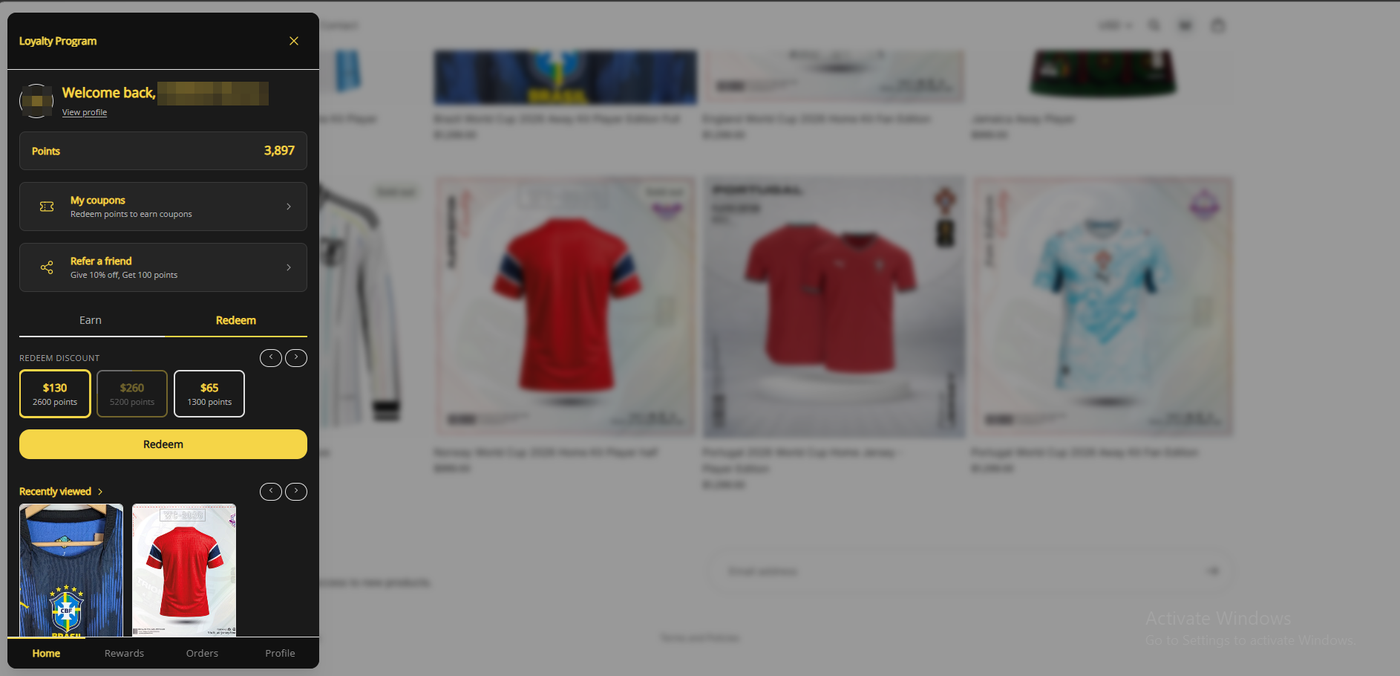
Yes. This was the strongest part of our hands-on test.
After completing a test purchase, Joy awarded points automatically. We did not need to manually credit the customer.
Redemption worked differently. The customer had to choose a reward manually and redeem available points. We found this part of the experience more confusing than earning points.
We did not notice a processing bug, unexpected delay, or incorrect reward behavior during this test.
The core loyalty loop worked:
purchase → earn points → redeem points → receive discount.
The mechanics were more convincing than the UX around them.
Checkout Result: The Redeemed Reward Applied Correctly
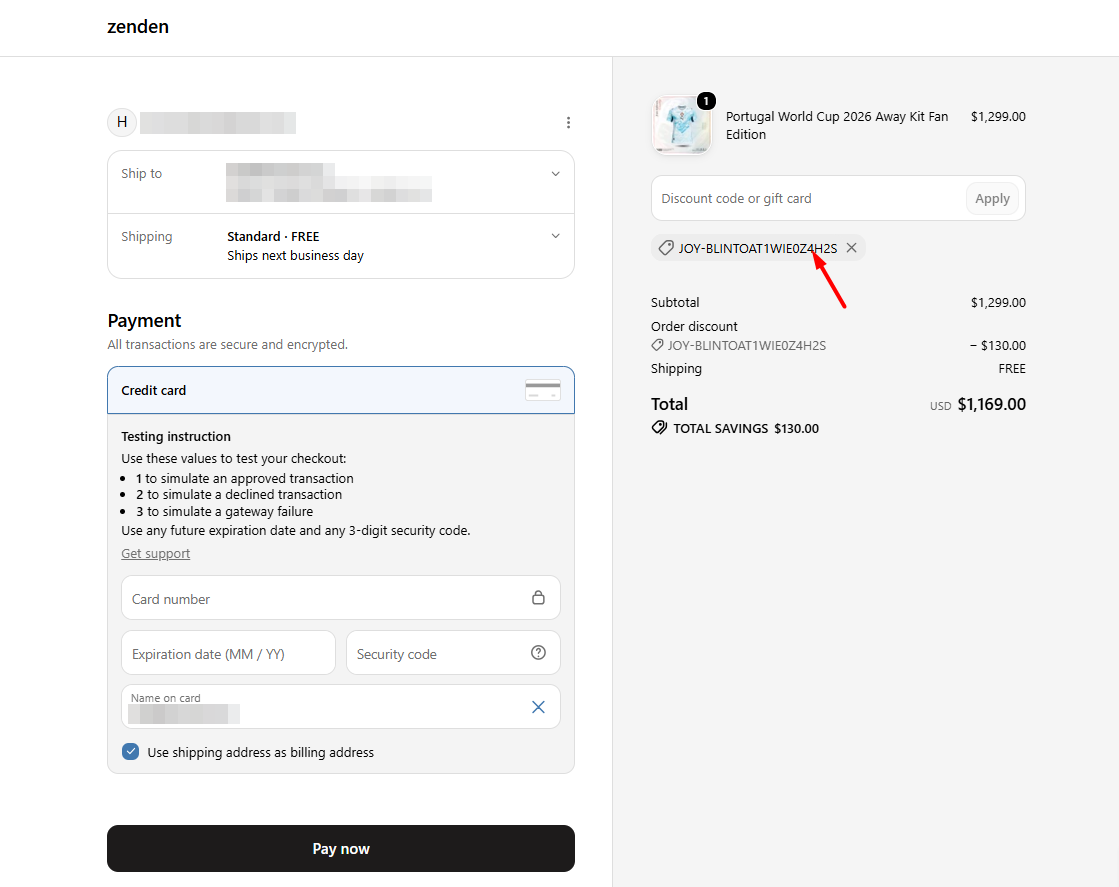
Once we successfully redeemed a reward, the generated discount worked correctly at Shopify checkout.
In our test, redeeming 2,600 points generated a Joy coupon code that Shopify checkout applied automatically as a $130 order discount on a $1,299 jersey, with total savings shown correctly. This confirmed that the reward moved beyond the loyalty widget and affected the actual Shopify order.
That matters because a loyalty app can look complete in the admin while still failing at the moment customers try to use the benefit. We did not see that problem here.
Customization Is One of the Easier Parts
Customization was noticeably easier than managing the reward flow.
We were able to change the widget appearance and review the result through Joy’s preview interface. The visual preview matched what we later saw on the storefront.
We did not encounter a meaningful customization problem during the test.
For merchants who want the loyalty interface to stay reasonably aligned with their storefront design, this part of Joy felt well executed.
Munna rated the customization experience Good.
Referral Setup
Joy also provides referral-program controls.
During setup, we could define rewards for the existing customer making the referral and the new customer receiving it. The interface also showed how the referral sequence was intended to work.
The referral configuration gives merchants control over incentives on both sides rather than rewarding only the referrer.
Our recommendation is based more heavily on the points and redemption workflow, where we collected the strongest hands-on evidence.
Pricing and Value
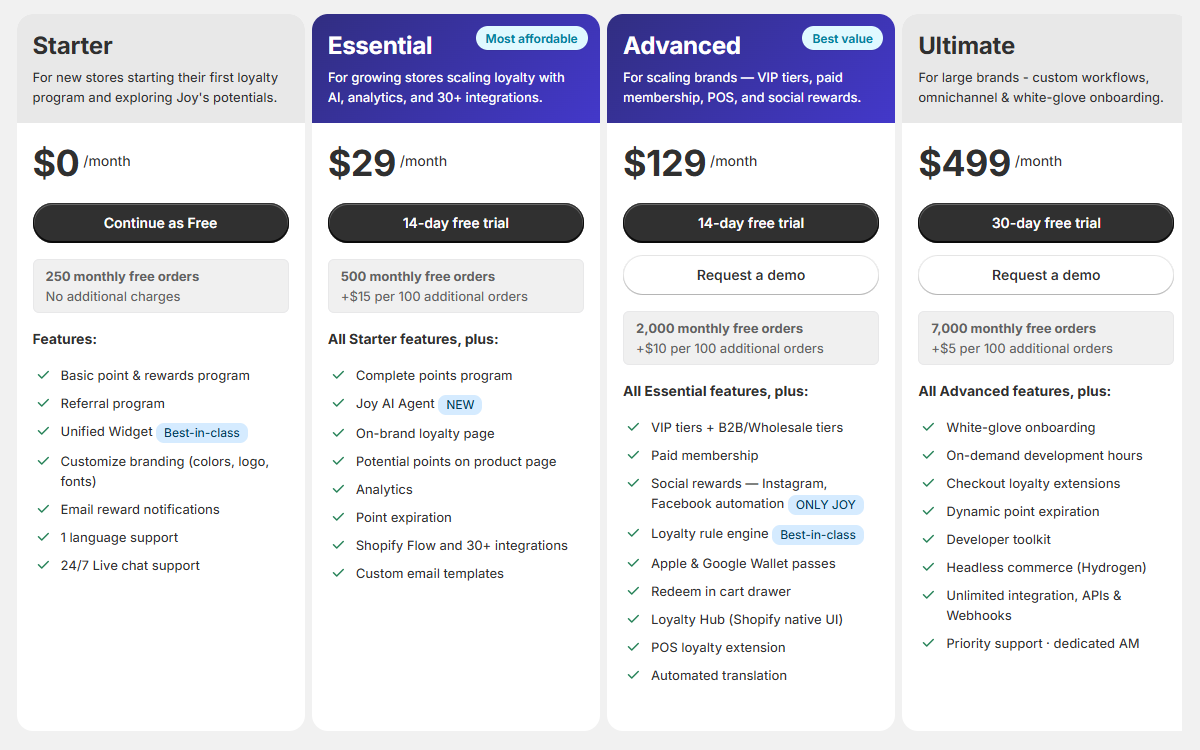
We verified the following pricing in September 2026. Prices and limits can change, so confirm the current details before subscribing.
| Plan | Price | Monthly orders included | Notable positioning |
|---|---|---|---|
| Starter | Free | 250 | Core points, rewards, referrals, and widget |
| Essential | $29/month | 500 | More complete loyalty tools, analytics, and integrations |
| Advanced | $129/month | 2,000 | VIP/B2B tiers, POS, membership, and advanced loyalty features |
| Ultimate | $499/month | 7,000 | Developer, headless, API, and higher-service features |
The current Shopify listing says Essential charges $15 per additional 100 orders above its included limit, Advanced charges $10 per additional 100, and Ultimate charges $5 per additional 100. Essential and Advanced show 14-day trials, while Ultimate shows a 30-day trial.
Munna rated Joy’s overall value Average.
The features are reasonable for the price, but nothing in our test felt exceptional enough to make the pricing stand out on value alone. The confusing UX also reduces the value somewhat because merchants may spend more time learning the system than expected.
The free plan does make Joy easier to evaluate before committing to a paid tier.
What Shopify Merchants Are Saying
On September 17, 2026, Joy’s Shopify App Store reviews showed a 4.9 rating from about 1.8K reviews, with the large majority at five stars.
A recurring positive theme is support. Recent merchants frequently describe Joy’s team as responsive and helpful, particularly during setup and customization. Other positive reviews mention flexible earning and redemption rules, POS functionality, and customization.
We did not test Joy’s support ourselves, so these are merchant-reported experiences rather than Blinto findings.
There is also merchant feedback that lines up with the usability concern we found. Some four-star reviews describe the large amount of customization as making launch more complex, and other merchants mention that parts of setup can be confusing even while rating the app positively.
Lower-rated reviews are a small minority and include individual complaints about specific customer-management and program issues. We treat those as individual merchant reports, not proof of a widespread problem.
What We Liked
- The core reward system worked: Purchases automatically generated points, and redeemed rewards successfully produced checkout discounts.
- Widget customization was straightforward: We could adjust the presentation without struggling through the design controls.
- Preview accuracy was good: What we configured in the preview was consistent with the live storefront experience.
- Broad loyalty feature set: Joy gives growing merchants room to expand beyond basic points into referrals and higher-tier loyalty tools.
None of these felt unusually differentiated during our test, but they cover the fundamentals a loyalty app needs.
What Could Be Better
- Simplify the UX: The biggest issue is the overall admin flow. Important loyalty actions should be easier to locate and understand.
- Make redemption clearer: Earning points happened automatically, while understanding how to redeem them required more exploration.
- Create a stronger guided workflow: First-time merchants would benefit from clearer direction connecting earning rules, rewards, storefront setup, and customer redemption.
The app did not fail technically during our tested loyalty flow. The weakness was mainly how easily a merchant could understand and operate it.
Who Joy Loyalty Program Is Best For
Joy makes the most sense for growing Shopify stores that expect their loyalty program to expand beyond basic points.
A merchant may start with simple purchase rewards and referrals, then later need features such as VIP tiers, additional integrations, POS loyalty, membership programs, or more advanced rules.
That broader feature path is Joy’s main appeal.
It is also a better fit for merchants who are comfortable spending some time learning a feature-rich interface instead of expecting an extremely minimal loyalty tool.
Who Should Upgrade or Consider an Alternative
Joy may be less suitable if your highest priority is an extremely simple admin experience.
The app gives merchants many controls, but our test did not find the navigation or redemption workflow especially intuitive.
Small stores that only need a very basic points program should also compare whether they actually need Joy’s broader feature set before moving to one of the higher paid tiers.
Merchants with VIP, POS, membership, or complex integration requirements should test those specific features themselves before choosing a paid plan because those areas were outside our hands-on test.
Final Verdict
Yes, we recommend Joy Loyalty Program, with UX being the main caveat.
The most important result from our testing is that the core loyalty mechanics worked. Customers earned points after purchases, could redeem those points for rewards, and the resulting discount applied correctly at checkout.
Customization was another positive area. Editing the loyalty widget was easy, and its preview matched the storefront.
The main weakness is usability. Joy would benefit from a clearer admin structure and a more obvious path through earning, reward configuration, and redemption.
For a growing Shopify store, though, Joy covers the main loyalty features it is likely to need.
As Munna summarized it: It covers the main loyalty features a growing store needs, even though the UX could be better.
Frequently Asked Questions
Is Joy Loyalty Program easy to set up?
We rated installation and onboarding Medium difficulty. Installation itself was manageable, but navigating the app and understanding the full reward and redemption workflow took more effort.
Does Joy automatically give customers points after an order?
In our test, yes. Points were added automatically after successful test purchases.
Can customers redeem Joy points for checkout discounts?
Yes. We manually redeemed points for a reward and successfully applied the resulting Joy-generated discount at Shopify checkout.
Does Joy have a free plan?
Yes. As of September 2026, the Starter plan is free for up to 250 monthly orders and includes core points and rewards, referrals, the loyalty widget, branding controls, and reward notifications.
Does Joy support VIP tiers?
The current Shopify listing includes VIP and B2B/wholesale tiers on its Advanced plan. We did not hands-on test those features, so our recommendation is not based on their performance.
Is Joy good for growing Shopify stores?
That is where we see the strongest fit. A growing store can start with points and referrals and has room to move into more advanced loyalty functionality as its requirements increase.